Harvest Shed
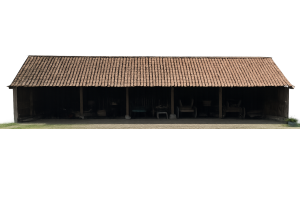
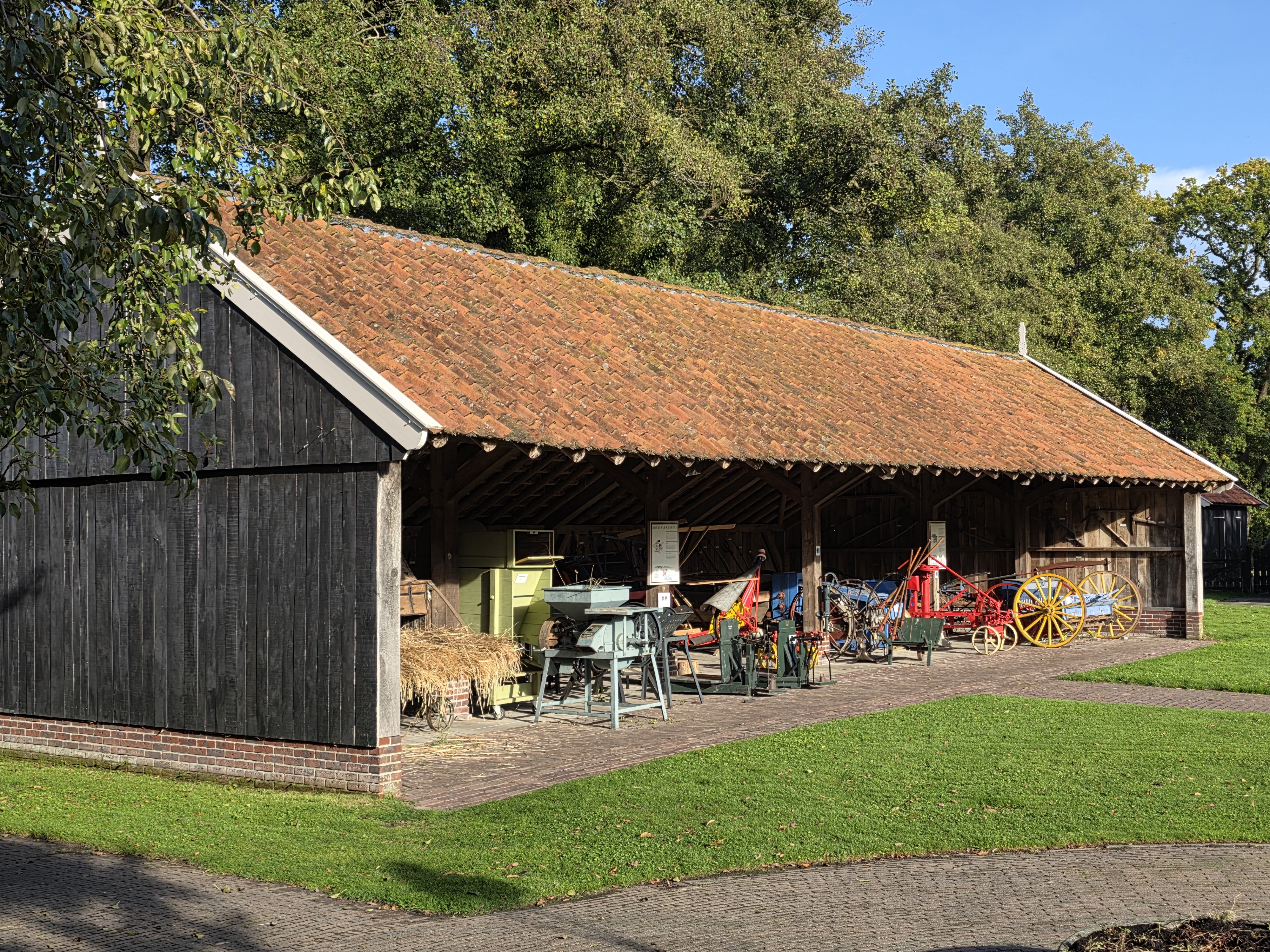
In the barn, you'll find tools for plowing, fertilizing the land, sowing, and harvesting.
It is sometimes said that “The Twente countryside was shaped by the hands of farmers.”
The bocage landscape of fields and pastures interspersed with tree-lined hedgerows is typical of this region.
Farming has undergone significant development over the years. In earlier times, the land was worked with wooden tools and horsepower; later, with tractors and an increasing number of machines.
There were tools for plowing, fertilizing the land, sowing, and harvesting.
At the beginning of the last century, mechanical farming became increasingly common, and today we see large, heavy machines—such as combines—that work large areas of farmland very efficiently. Things used to be quite different: laborious manual labor using simple tools.
Since prehistoric times, people have shaped the land to their will. The development of agriculture has been the driving force behind this. Unlike the primitive hunter, the farmer transforms his environment and influences the nature around him. Initially, the farmer enriches nature. The variety of landscape types created by human intervention opens up opportunities for new plant and animal species. The prehistoric peoples who lived in this region, in the vast primeval forests, initially engaged in a form of overexploitation. On the moraines and sandy soils, the higher parts of the primeval forest were burned to the ground, and wheat was grown on the resulting small fields.
No fertilizer was used; once the soil was depleted after a number of harvests, a new field was cleared in the forest. The old field was used as pasture for pigs and small cattle. The forest no longer had a chance to regrow on the depleted soil, and over time, heathland developed in these areas—which, much later, would cover large parts of Twente. More and more of the higher-elevation forest is cleared to make way for pastures and farmland. A direct consequence of this is accelerated water runoff through the stream valleys, which, in lower-lying areas, leads to flooding, marshlands, and the formation of swamps. Erosion creates fertile stream valleys, and after the birch forests that formed here were cleared, these areas gave way to flower-rich hayfields.
Arable farming was concentrated in the higher-lying areas. Here, contiguous agricultural areas—the so-called “essen”—emerged. At the edges of the essen, we find pastures, known as “Hooilanden.” These were preferably located near water and close to the farm. These pastures were surrounded by fencing and vegetation such as pollarded willows. It is these hedgerows that make the Twente landscape so attractive.
Around 800 A.D., the first villages and towns emerged here. They were still just small settlements in a wild region. The population consisted of tribes or family groups allied with the Saxons, primarily the Tubanti, after whom this region is named. Their beliefs bore many similarities to Norse mythology. Freya, Tyr, and Wodan were the gods who were worshipped. Even today, traces of that ancient era can still be found in Twente.

The Harvest Barn – Early Agriculture
Listen and read
Listen and read
The Harvest Barn – Early Agriculture
It is sometimes said that “The Twente countryside was shaped by the hands of farmers.”
The bocage landscape of fields and meadows interspersed with tree-lined hedgerows is typical of this region.
Farming has undergone significant development over the years. In earlier times, the land was worked with wooden tools and horsepower; later, with tractors and an increasing number of machines.
There were tools for plowing, fertilizing the land, sowing, and harvesting.
At the beginning of the last century, mechanical farming became increasingly common, and today we see large, heavy machines—such as combines—that work large areas of farmland very efficiently. Things used to be quite different: laborious manual labor using simple tools.
Since prehistoric times, people have shaped the land to their will. The development of agriculture has been the driving force behind this. Unlike the primitive hunter, the farmer transforms his environment and influences the nature around him. Initially, the farmer enriches nature. The variety of landscape types created by human intervention opens up opportunities for new plant and animal species. The prehistoric peoples who lived in this region, in the vast primeval forests, initially engaged in a form of overexploitation. On the moraines and sandy soils, the higher parts of the primeval forest were burned to the ground, and wheat was grown on the resulting small fields.
No fertilizer was used; once the soil was depleted after a number of harvests, a new field was cleared in the forest. The old field was used as pasture for pigs and small cattle. The forest no longer had a chance to regrow on the depleted soil, and over time, heathland developed in these areas—which, much later, would cover large parts of Twente. More and more of the higher-elevation forest is cleared to make way for pastures and farmland. A direct consequence of this is accelerated water runoff through the stream valleys, which, in lower-lying areas, leads to flooding, marshlands, and the formation of swamps. Erosion creates fertile stream valleys, and after the birch forests that developed here were cleared, these areas gave way to flower-rich hayfields.
Arable farming was concentrated in the higher-lying areas. Here, contiguous agricultural areas—the so-called “essen”—emerged. At the edges of the essen, we find pastures, known as “Hooilanden.” These were preferably located near water and close to the farm. These pastures were surrounded by fencing and vegetation such as pollarded willows. It is these hedgerows that make the Twente landscape so attractive.
Around 800 A.D., the first villages and towns emerged here. They were still just small settlements in a wild region. The population consisted of tribes or family groups allied with the Saxons, primarily the Tubanti, after whom this region is named. Their beliefs bore many similarities to Norse mythology. Freya, Tyr, and Wodan were the gods who were worshipped. Even today, traces of that ancient era can still be found in Twente.

The Harvest Shed - Tools
Listen and read
Listen and read
The Harvest Shed - Tools
There is a well-known saying: “And the farmer plowed on.” The land was tilled using a wooden plow and, later, an iron plow, pulled by an ox or by horses. The soil was loosened so that seeds could be sown and plants planted. The soil had to be fertilized. When the crops sprouted, weeds had to be pulled, and when the harvest was ripe, it had to be brought in.
That was hard work. A well-known saying goes, “If the farmer just sits on his butt, no potatoes will come out of the ground…” Rye, oats, wheat, and barley were grown there. During harvest, these crops were cut with a scythe, known as a “zicht.” The crops were gathered into bundles, called “sheaves.” These sheaves were placed side by side in the field to dry, forming “stacks.” Fully loaded wagons were taken to the farm, where the chaff was separated from the grain. The seeds were taken to the miller, who ground them into flour, and the baker used this flour to bake bread. The farmer’s wife usually had a small vegetable garden next to the farm for her own use.
Over the years, agriculture became increasingly mechanized. The horse disappeared, and the tractor arrived. Ingenious machines for sowing, planting, and processing the harvest were used more and more. Threshing machines, potato harvesters, choppers, etc., were designed to make the work easier. If you take a look at the Twente countryside today, you’ll see the large combines from the agricultural equipment companies that, during harvest time, bring the corn, rye, or oats straight off the field and process them all at once, allowing the harvest to go directly to the factory. Things used to be quite different. Small farmers engaged in both crop farming and livestock raising and had to work all day long just to make a living. “A skinny cow and a fat horse aren’t worth a thing to a farmer.”