Los Hoes
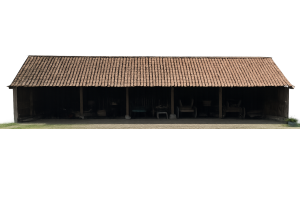
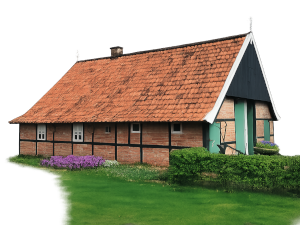
The Los Hoes is a type of farmhouse where people and animals live together in the same space. The farmhouse could be easily moved.
The "Los Hoes" is a type of farmhouse where people and animals live together in the same space. “Hoes” means “house,” and “los” in the Twente dialect means, among other things, “open.” So here, you “open” the door or window. It has also been suggested that the “los” in “los hoes” means “not fixed.” In other words, the farmhouse was movable. After all, the trusses, the timber framing, and the load-bearing structure are founded on field boulders and are easy to dismantle. It was also said to be classified as personal property for tax purposes. This is a myth. Archaeological research shows that since the mid-13th century, the Twente farmsteads have been located more or less in the same place.
This Los Hoes dates back to 1664. On April 6 of that year, Lambert te Gronvelt and Tryne, his wife, held a so-called “richtersmoal” to thank all the neighbors who had helped erect the trusses. This is recounted in the inscription on the barn door arch. Standing with your back to the large front door, you can see the cowshed on the left. The pigsty was on the right. Next to the pigsty was the weaving room, and behind that, the milking room. On the left were the box beds. People were smaller back then but often slept sitting up. There was a superstition that if you lay on your back, all the blood would rush to your head and you would die. Moreover, sleeping sitting up provided relief for the lungs.
The best part of a “Los Hoes” was the attic. This is where the harvest was stored. The attic was covered with “sleeten,” long, thin tree trunks. The smoke from the Losse fire drifted through these sleeten and killed any insects still present in the harvest. At bedtime, the fire pit was placed on top of the still-smoldering fire. This was to prevent the cat from getting too close. After all, a cat—also known as a “balknhaas”—could get anywhere in the farmhouse, and if a burning “balknhaas” fled to the hayloft, things could get pretty hot in there…

Los Hoes - Interior
Listen and read
Listen and read
Los Hoes - Interior
In the evenings, people would gather around the open fire to tell each other exciting stories and legends—tales featuring the supernatural, from the Héémannekes to the Kardoeshond.
Whenever a “Todde” or a “Kiepenkerl”—a peddler—passed by, the latest news was passed along “from campfire to campfire.” It spread like wildfire throughout the village. The Todden lived about 50 kilometers across the border in Germany; they came from Oldenburg, Mettingen, and even Münster. Two brothers, Carl and August Brenninkmeijer, were famous:
C&A and the Peek and Cloppenburg family. These Todden sold all sorts of things: mainly textiles. It was said that if there were a place in the world where no Todde had ever been, that place probably wasn’t worth the trip anyway. The Toddes bought linen in rolls from home weavers. They knew exactly where the skilled weavers lived, and in the spring they would purchase from them the rolls of linen they had ordered in the fall to resell elsewhere. It was a true art to roll the linen into tight, elegant rolls. These linen rolls, called “dookrollen,” were stored in the “kamnet” (cabinet). This linen cabinet was displayed on special occasions to showcase the family’s wealth. If the rolls weren’t wide enough for the cabinet, a small block of wood would sometimes be placed behind them, out of sight, to make them appear wider. The rolls were also often given as gifts. Anyone who had a spot “in the kamnet” held a privileged position within that particular family. The linen could spoil due to moisture, becoming moldy. You therefore had to inspect the quality during the day in daylight. “You shouldn’t store linen and women by lamplight.”
Next to the ‘kamnet’ stands the ‘spinde,’ the pantry. The best and tastiest food was stored on the top shelf. Above the fire hangs the “haol,” or the hanging iron. This is where the kettle hangs for boiling water or a support for placing the frying pan. We all know the hot hanging iron—you’d rather not touch it. The maid’s last chore of the week, before she had the day off, was cleaning the ‘haal’. Then she could go on her way.

Los Hoes - Box Spring, Goastok
Listen and read
Listen and read
Los Hoes - Box Spring, Goastok
The farmer and his wife slept in the box bed closest to the livestock. The other box bed was for the children. Up to four small children could sleep in a single box bed—two with their heads on one side and two with their heads on the other. The farmhand and the maid slept on the low loft floor, called the “hiel.” If there were many children, a small bed or large drawer would sometimes be set up under the parents’ box bed; this is where the “underrated child” would sleep.
Right next to or inside his box bed, the farmer kept his walking stick. A magnificent walking stick with which he could walk, goan, and ward off danger, sloan. The walking stick is made by nature. Wrap a honeysuckle around a branch and let both grow together. Cut the branch when it’s big enough, remove the honeysuckle, and attach a round knob to it.
A lovely story about a walking stick is that of Gait. Gait wasn’t afraid of the devil, and he’d say so at every opportunity. You couldn’t run into Gait without him saying, “I’m not afraid of the devil.” Gait’s sister had been invited to a spinning party in Vasse, and Gait had to carry the spinning wheel. Marietje was there too, and it was a lot of fun. But during the spinning party, the weather got worse and worse. A massive thunderstorm was approaching. The weather actually got so bad that the farmer’s wife said, “Kids, you’re welcome to stay the night.” That’s how bad the weather really was.
But Gait… “Gait wasn’t afraid of the devil,” his friends said, “so he might as well go home.” Gait couldn’t back down; he didn’t want to lose face. He grabbed his walking stick and set off through the rain and storm. In the barn, his friends find a cowhide and a cow skull, and they decide to teach Gait a lesson. His best friend drapes the hide over himself and puts on the skull. He hides in the ditch along the country road. Gait comes walking by with his cane; a flash of lightning illuminates the field, and his friend jumps up: “Boo, Gait! I’m the devil!”
Gait is scared out of his wits, but doesn’t hesitate for a moment. He grabs his cane and strikes the devil right between the eyes. The next moment, it’s dark again and the devil has vanished. Gait feels like a real man and walks home through the rain, whistling. The next day, he runs into his friends in town and proudly tells them about his heroic deed. His friends then go searching and find Gait’s best friend in the ditch with a gigantic bump on his head. According to the story, Gait was never invited on a fishing trip again.
So there you have it: you don’t need to be afraid of the devil—you just shouldn’t brag about it.