Eppink Barn
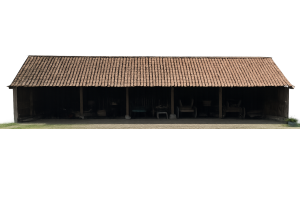
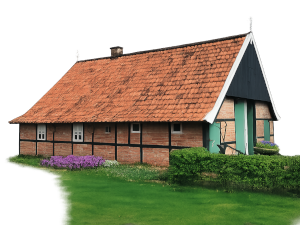
This “Los Hoes”-style city farm was located on the waterfront in Ootmarsum and was home to the Eppink family.
This “Los Hoes”-style city farm was located on the embankment in Ootmarsum and was inhabited by the Eppink family. In Low Saxon, the suffix “ink” or “ing” in personal names means “son of.” Thus, “Eppink” means “son of Eppe,” and “Geerdink” means “son of Geerd.” Many surnames in this region have such a suffix.
The farmhouse was dismantled by volunteers in the 1970s and moved to the open-air museum. Nearly all the buildings on the museum grounds are relocated structures. During the relocation and reconstruction, the remaining historical building materials were used wherever possible. Because the buildings have been moved, they are no longer designated as historic monuments.
At the Eppink city farm, the original layout is barely recognizable. The exterior, however, still reveals its original function. In particular, the large entrance doors that provided access to the “deel,” the farm’s work area. These doors can be opened completely, after which the central post, the “stiepel,” can be removed. The wide entrance created in this way allows the farmer to drive the farm wagon into the house and unload the harvest into the attic. The barn was located at the rear, the back end of the farmhouse.

Court System
Listen and read
Listen and read
Court System
The manorial system is a system for managing estates—known as “manors”—that dates back to the early Middle Ages. The lord divided his estates into smaller parcels organized around a central manor or farmstead. These small units were allocated to serfs.
During the turbulent early Middle Ages, many small farmers sought protection from a lord. The relationship between lord and farmer was defined according to the lord’s power; as a result, these relationships could vary by place and time. These farmers became serfs.
A serf was a farmer with certain obligations to a lord. They did not own the land but did have rights of use, could accumulate property, and had a say in the inheritance of the farmstead they managed. With these rights came obligations. These could include surrendering a portion of the harvest or providing manual labor for the lord—known as manorial services. The relationship was reciprocal; the lord also had duties toward the serfs. For example, the lord was responsible for their safety. The serf was bound to the land and could therefore not move without his lord’s permission. If the land passed to another lord, so did the serf. The rights and obligations between serf and lord were subject to constant negotiation between both parties.
Acts of war, crop failures, failure to fulfill obligations, or a lack of income on the part of the lord were all circumstances that could lead to adjustments in rights and obligations.
The lists of goods that serfs were required to pay provide a good picture of the products cultivated in this region during the Middle Ages. The lists included, among other things: rye, barley, oats, beans, berries, honey, malt, pike, sheep, pigs, chickens, and cattle. As the Middle Ages progressed, more and more rent was paid in cash.

Hofmeier/Van Beverforde
Listen and read
Listen and read
Hofmeier/Van Beverforde
At the head of the manor stood a man known as the steward. Originally a serf, he was able to lead others due to his personality and authority. The steward was responsible for the day-to-day operations of the manor. Acting as the lord’s representative, the steward adjudicated disputes among the serfs, managed the estate, and collected the taxes and rents owed by the serfs for the use of the lord’s property.
Since the early Middle Ages, the most powerful lord in Overijssel had been the Bishop of Utrecht. The area over which the bishop ruled as a prince was also known as “het sticht.” The bishop’s extensive estate on the IJssel River is known as “het oversticht” and encompassed the entirety of Overijssel, Drenthe, and the city of Groningen. To manage this effectively, the bishop established various manorial systems in Twente.
Ootmarsum served as the main court in Twente. If a serf—for example, one belonging to the Oldenzaal court—disagreed with a decision made by their own court steward, they could appeal to Ootmarsum. In the late Middle Ages, the Ootmarsum manorial estate comprised approximately 140 farmsteads. These farmsteads formed a patchwork of holdings; some of them were located in what is now the County of Bentheim, across the border in Germany.
The Bishop of Utrecht was not the only lord in Twente with serfs who were administered through a manorial system. Another major manorial system was that of the Teutonic Order, which owned the Commandery—the castle complex in Ootmarsum that once stood on this site.
In 1527, ownership of the episcopal manors passed to Emperor Charles V and subsequently to his son Philip II. After Philip II was deposed during the Eighty Years’ War, the episcopal manors came into the hands of the States of Overijssel. In practice, little changed, except that the van Beverforde family passed down the office of court steward from father to son. The first van Beverforde to hold this office was Reint van Beverforde in 1612; he was married to a niece of his predecessor. The family acquired extensive landholdings and rose to prominence.
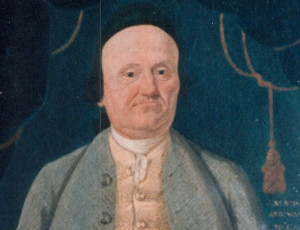
Around 1720, Jan Hendrik van Beverforde was able to afford to have portraits painted of himself, his wife, and his son Hermannus.

Staten Bible
Listen and read
Listen and read
Staten Bible
For Twente and Overijssel, the Eighty Years’ War was a time of plunder and decline. Dutch and Spanish troops ran rampant in the countryside. Farmsteads were abandoned and farmland lay fallow. Calvinism had few followers among the population; indeed, the Iconoclastic Fury passed Overijssel by entirely. Oldenzaal remained under Spanish control for a long time.
Protestantism, which was forcibly introduced, found little support, and large parts of Twente remained Catholic.
Although freedom of conscience officially prevailed in the Republic of the Seven Provinces after the Eighty Years’ War, every Dutch citizen was expected to convert to the Reformed Church. Life was not made easy for Catholics. Their church buildings were confiscated. Secret gatherings were organized in clandestine churches and barn churches. Membership in the Reformed Church was mandatory to hold public office.
A point of contention during the Reformation was the question of for whom the Bible was intended. The Catholic clergy believed that the Bible should preferably not be read by ordinary people; instead, they could listen in church to the clergy’s explanations as they read the Bible in Latin. The clergy acted as mediators between God and the faithful.
The Protestants, on the other hand, believed that every believer should read the Bible for themselves and that a pastor was, first and foremost, a servant of the Word of God. This also meant that the Bible had to be available in one’s own language, preferably in a translation that was as reliable as possible. In 1618, the Synod of Dordrecht commissioned a translation from the Greek and Hebrew. This “States Bible”—so named because it was funded by the States General—served as the standard Bible for 300 years and had a major influence on Dutch culture and language. The translation was completed in 1637, and between 1637 and 1657, several hundred thousand copies were printed. Expressions such as “by the sweat of his brow,” “carried on people’s hands,” and “a feast for the eyes” originate from the States Bible.
Harmannus van Beverforde
Listen and read
Listen and read
Harmannus van Beverforde
Hermannus was born in 1725, the son of Jan Hendrik van Beverforde and Maria Keller van Neuenhaus. His father, Jan, came into possession of Hof Ootmarsum shortly before Hermannus’s birth, following a long-drawn-out inheritance dispute. This estate comprised real property that had been accumulated over the centuries through gifts and purchases within a system of serfdom. Jan had to dig deep into his pockets to acquire it and took out two mortgages. In fact, the estate had been in the hands of the van Beverforde family by inheritance since 1612. They bore the title of Hofmeier, steward of serf estates, but in reality they were large landowners.
In 1748, Hermannus married Antonetta ten Cate. Antonetta’s sister Anna married Johan Georg Dröghoorn at almost the same time. . Hermannus and Antonetta’s marriage was short-lived, as Antonetta died in childbirth just three days after the birth of their son Anthony in 1756.
In 1767, Hermannus married for the second time, this time to Mettina Alegonda Cramer-Knijpinga. She was originally from Groningen and was the widow of Hermannus Cramer of Ootmarsum. Both brought a son from their previous marriages: Hermannus, Anthony van Beverforde, and Mettina, Hendrik Knijpinga Cramer. They moved into the Hofmeiershuis on the main street in Ootmarsum. The two stepbrothers never got along. There were many arguments and conflicts over financial matters. This was a source of great sorrow for Mettina, who, in desperation, even attempted suicide in the town canal running behind the house.
Three prominent Ootmarsum families were thus linked to one another: the van Beverforde and Dröghoorn families through Hermannus’s first wife, and the van Beverforde and Cramer families through his second wife. All three were part of Ootmarsum’s predominantly Reformed administrative and civic elite. Hermannus died in 1792 and, as a man of importance, was buried in the Great Church (Protestant at the time).
Burial in the church was reserved exclusively for important people. Often, the grave would remain open for a while, causing an unpleasant corpse odor in the church. Hence the expression “rich stinkers.”

Atlas
Listen and read
Listen and read
Atlas
An atlas is a status symbol. It indicates that the owner has knowledge of the world.
This atlas contains a series of copper engravings of maps and bird’s-eye views. The maps were created by various cartographers and publishing houses. The oldest engravings date from 1605 and were printed/produced by Nicholaas Visscher. The most recent engravings are from the Seutter publishing house and date from the late 18th century. In addition to Seutter and Visscher, the atlas also contains engravings by de Witt, Ottens, Hommano, and others. In total, the atlas contains 124 partially colored maps. An atlas of this kind was a major status symbol and a valuable possession. Its owner possessed knowledge of the world. The maps illustrated how the world had expanded through voyages of discovery and trade contacts. The maps themselves were exceptionally beautifully executed, though often outdated. Accuracy was of secondary importance. The atlas indicated that the owner was “a man of the world,” erudite and well-read.

Johan Georg Dröghoorn
Listen and read
Listen and read
Johan Georg Dröghoorn
Johan Georg Dröghoorn, the father of Wennemar Hendrik, was a wealthy man until the mid-1770s. He succeeded his father as steward of the Huys Ootmarsum and also served as steward of the stadtholder’s estate in the County of Bentheim. In addition, he derived income from his own farms, houses, and parcels of land. Furthermore, the bailiff of Twente, Baron van Heiden Hompesch, owed him a total of 13,000 guilders.
In 1775, he was dismissed by the bailiff without any explanation. When he subsequently tried to recover his money, the drost would only agree to pay with debts that the farmers owed to the drost. Van Heiden ensured that Johan Georg also lost his job as steward of the stadtholder’s estates. Johan Georg had no choice but to accept the debt swap and was then faced with the thankless task of collecting his 13,000 guilders from “the poor folk.” Whatever the bailiff and his new steward thought they could not collect, Johan Georg was tasked with collecting.
The story goes that Johan Georg still seeks revenge for the injustice done to him. They say he still haunts the Ageler Broek as the little red man in the marsh. To collect his debts from the farmers, Johan sets out, wearing a red jacket. Johan is a clever fellow and manages time and again to surprise the farmers and recover a good portion of his capital.
In 1795, Johan died and, according to the story, was buried in the Ageler Broek on the left side of a birch tree. A year later, his family and loyal followers visited the grave. To their surprise, it was now located on the right side of the birch tree. Every year, the grave moves toward Ootmarsum. At first quickly, but gradually more slowly, and eventually at a rooster’s pace—one rooster’s step per year. A few years after his death, several children from Ootmarsum disappear in the Ageler Broek. They likely drowned in the marsh, but rumors soon spread throughout the town that the Little Red Man was behind it. Subsequently, his shadow is seen more and more often around farmyards in Tilligte and Agelo. The little red man is said to lure unsuspecting walkers into the marsh with a red light to steal their money. In a few years, his grave will arrive at the museum—the very place where his hated boss once lived. Who knows what will happen then?