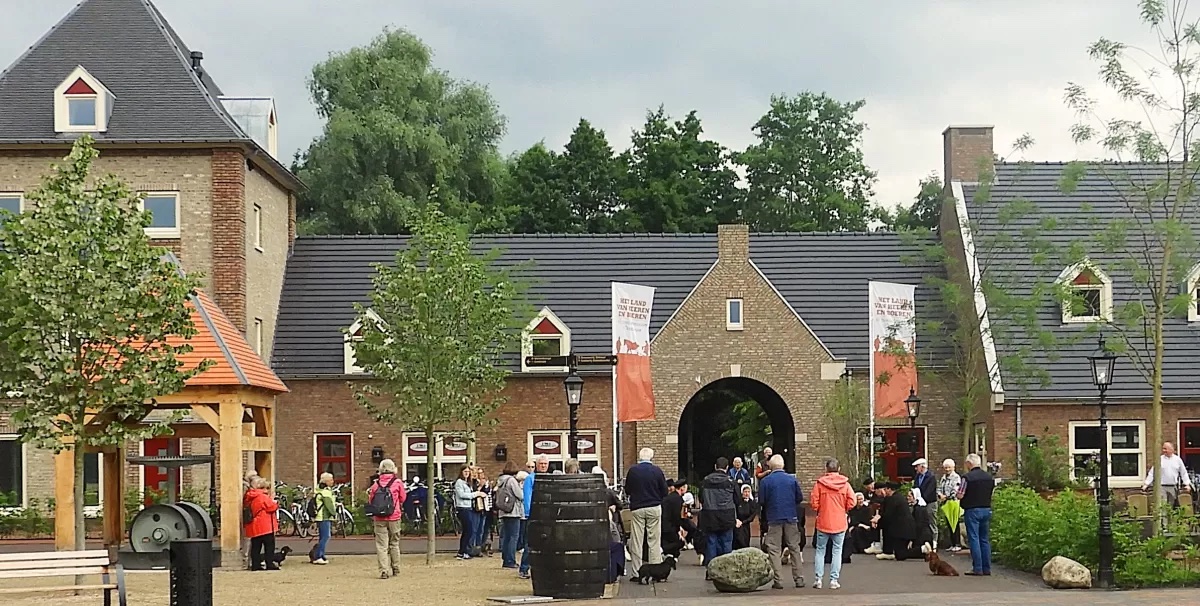
Main Entrance
"Hey, come on in so you can take a look around. Everyone’s welcome—come on in, and you can look outside.
The museum is like “a” story. A story about people—about where and how they lived, what occupied their minds, what they ate, how they slept, their customs and crafts, about language and traditions, about faith, about poverty, struggle, and wealth, about war and peace.
This story is about knights, lords, neighbors, barons, citizens, and bishops. About textiles, agriculture, facade symbols, and “klöpkes.” About governance and development.
And all of this for education and entertainment. So that we may know who we are and where we come from, what drives us, and perhaps even why.
Museum
This museum tells the story of this region. The land of the Tubanti, Twente: the land of lords and farmers. The local dialect is a variant of Low Saxon. Low Saxon is an officially recognized regional language. The language area encompasses all of northern Germany up to the Polish border and across the Danish border. In the Netherlands, Low Saxon is spoken in Groningen, Drenthe, Overijssel, southern Friesland, the Veluwe, and the Achterhoek. In the Middle Ages, Low Saxon was a very prominent language; it was the official language of the Hanseatic League. As a language, Low Saxon is highly endangered. Only 25 percent of adults and 4 percent of their children in the language area speak Low Saxon. In recent years, there has been a renewed appreciation and interest in the language. The success of the regional soap opera *Van Jonge Leu en Oale Groond* is an example of this. Oh, and by the way, a “gieteling” is a blackbird, and if you’re lucky, you might spot a “kateeker” (a squirrel).
A wonderful way to experience the history of Twente
Listen and read
Listen and read
A wonderful way to experience the history of Twente
The Ootmarsum Open-Air Museum has the subtitle “Land of Lords and Farmers.” The museum offers a glimpse into how people in Twente lived two hundred years ago. It showcases not only the farmers—who, as tenant farmers, often led a tough, impoverished, and lonely existence—but also the “Lords,” who were appointed to manage the estates. There were many “high lords” in Ootmarsum: the Hofmeier, who was tasked with managing more than 100 farms on behalf of the bishop; the Drost of Twente, who was appointed by the stadtholder and had the authority to administer justice and collect taxes; and the Commander, who lived at the now-vanished Commandery of Ootmarsum, a monastery of the Teutonic Order.
The residence of the last Drost of Twente is open to visitors; the museum park features an exhibition on the Hofmeiers, and work is underway on an exhibition about the Commandery of Ootmarsum.
And the farmers? Well, “The farmer plowed on…” .
Most of the museum park shows how farmers used to live. Close to nature, simple, self-sufficient, and traditional. Farming, housing, livestock raising, traditions, clothing, tools, and skills such as weaving, spinning, woodworking, blacksmithing, etc.—it’s all covered. Of course, it’s nice to reread the accompanying texts from the audio tours, but it’s naturally much more exciting to come back and immerse yourself in the rural life of Twente from two hundred years ago.
The museum is like a story
Listen and read
Listen and read
The museum is like a story
“Hey, come on in so you can take a look outside.” Everyone, welcome—come on in so you can look outside.
The museum is like a story. A story about people; about where and how they lived, what occupied their minds, what they ate, how they slept, their customs and crafts, about language and traditions, about faith, about poverty, struggle, and wealth, about war and peace.
This story is about knights, lords, neighbors, barons, citizens, and bishops. About textiles, agriculture, facade symbols, and “klöpkes.” About governance and development.
And all of this for education and entertainment. So that we may know who we are and where we come from, what drives us, and perhaps even why.
This museum tells the story of this region—the land of the Tubanti, Twente: the land of lords and farmers.
The local dialect is a variant of Low Saxon. Low Saxon is an officially recognized regional language. The language area encompasses all of northern Germany up to the Polish border and across the Danish border. In the Netherlands, Low Saxon is spoken in Groningen, Drenthe, Overijssel, southern Friesland, the Veluwe, and the Achterhoek. In the Middle Ages, Low Saxon was a very prominent language; it was the official language of the Hanseatic League. As a language, Low Saxon is highly endangered. Only 25 percent of adults and 4 percent of their children in the language area speak Low Saxon.
In recent years, there has been a renewed appreciation and interest in the language. The success of the regional soap opera *Van Jonge Leu en Oale Groond* is an example of this.
Oh, and by the way, a “gieteling” is a blackbird, and if you’re lucky, you might spot a “kateeker” (a squirrel).
Goodgoan
Listen and read
Listen and read
Goodgoan
“Have a great trip,” people here often say when you’re leaving. We hope that this journey through the bygone days of the lords and farmers in Twente was not only an enjoyable trip, but also a time for reflection.
In today’s Twente, you can still sense the spirit of the sturdy, hardworking people with their down-to-earth outlook on life. Here, they have “plenty of time.” Slowing down and being yourself is a great remedy for stress.
We hope to welcome you again someday to the Land of Lords and Farmers, and for now we say: