Weemhof
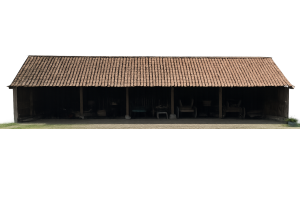
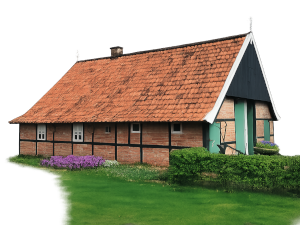
This is one of the oldest buildings on the grounds, the former restaurant "De Wanne"
De Weemhof may appear to be the newest building on the grounds, but at its core it is one of the oldest. The truss—the load-bearing structure—and the wooden beams date back to the 14th or 15th century. As is typical of high-quality timber framing, this framework has been reused several times. For example, from 1969 to 1997, the framework formed part of the exclusive restaurant “de Wanne.”
The name Weemhof is derived from “weem” or “wheeme,” a term for a parsonage. The meaning traces back to the Old Frisian word “wetheme,” which refers to church property. Many villages and towns have a “Weemstraat,” and “weem” occasionally appears in surnames such as “Oude Nieuwe Weme.”
Inside the building, you can view rotating exhibitions and watch a short introductory video about the museum.
You’ll also find here the origins of the textile industry in Twente. In the last century, that textile industry provided employment to many thousands of people in the numerous factories that were located here. This industry began as early as the 18th century on farms, where—especially during the winter months—farmers and their wives would spin yarn on a spinning wheel—often from flax they had grown themselves—and weave it into linen fabric on a loom.
The large mosaic comes from the Twente Textile School in Enschede, where it was installed in the school building in 1952. In 2017, the artwork by Nel Klaassen was moved to this location.
The historic loom illustrates just how much work it took to weave a piece of fabric. Do you know where the proverb “Op z’n elf en dertigst” comes from? Well, on a loom like this there is a “beam” on which the yarn was stretched into 30 groups of 100 threads each. By alternately moving these threads—the warp—up and down and passing a bobbin with a thread—the weft—through them, the linen fabric was created. If you wanted to make a very strong fabric, you’d add 11 groups of 100 threads each. That was a lot of work, and as a result, the weaving took much, much longer. So anything that took a long time was said to go “at a snail’s pace.”
When there was something to celebrate—for example, if a farmer had a new arrival, such as a young calf or a foal—he would treat everyone to a shot of raisins in brandy. Boerenjongens. The name has nothing to do with boys. “Boerenmeisjes” (farm girls) and apricots in brandy are a politically correct invention from a later date. In the old days, if the innkeeper trusted you, you might get credit. Then you could drink the Boerenjongens and pay later. He would then record your debts on a stick by making notches with a knife. The stick is called a “kerfstok.” The proverb “to have something on the kerfstok” is therefore not a positive expression.